Your competitors are publishing content every week. But here's the problem: most B2B teams never actually analyze what they're doing. They notice competitors publish something. They glance at the headline. Then they move on.
That's monitoring. Not analysis.
Real competitive analysis means understanding why certain content ranks, what topics competitors completely miss, and how to find angles they haven't discovered yet. The difference between these two approaches matters. One wastes your time. The other wins you rankings and leads.
Companies that master competitive analysis publish faster, rank higher, and differentiate more consistently. Companies that skip it struggle to gain organic visibility.
Here's what makes this hard: most teams lack a systematic process. Analysis feels scattered and time-consuming. Some people spend 30 or more minutes researching a single article's competitive landscape without knowing what they're looking for. Others skip research entirely because they don't have a framework to guide them.
The good news? You don't need to become a research expert. You need a system.
Meet the GAPS Framework
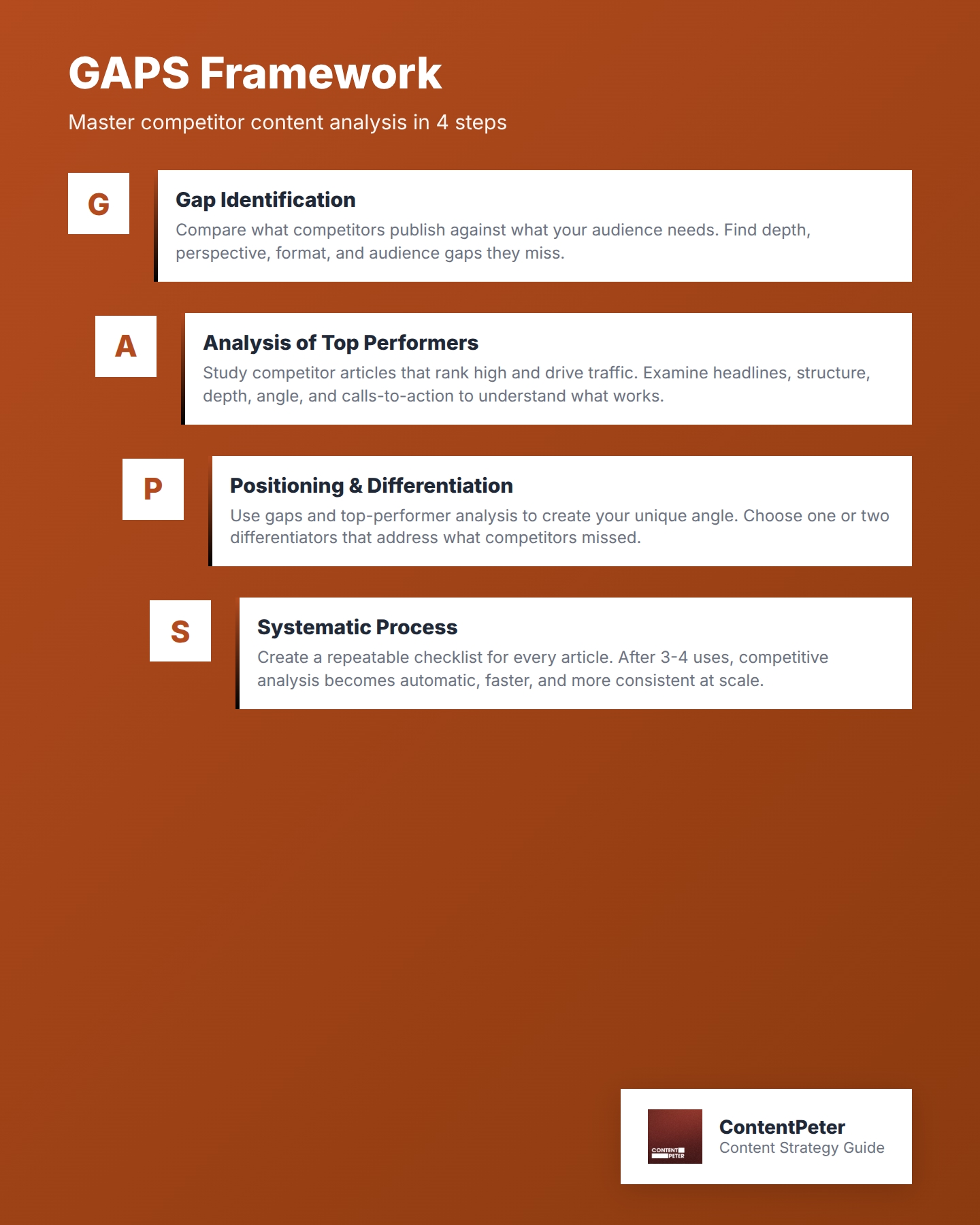
The GAPS framework simplifies competitor content analysis into four focused steps. This system helps you find the content gaps competitors leave open, understand why their top performers work, position your content to stand out, and build a repeatable process you can use for every article.
Here are the four components:
G = Gap Identification (finding what competitors miss)
A = Analysis of Top Performers (understanding what works)
P = Positioning & Differentiation (creating your unique angle)
S = Systematic Process (repeating this at scale)
Let's break each one down.
Step 1: Gap Identification (Find What Competitors Miss)
Gap Identification means comparing what competitors publish against what your audience actually needs. The goal is to discover topics, angles, and formats competitors mention but never fully explore.
This matters because the average topic has 3 to 5 significant content gaps. These gaps are opportunities. When you fill them, you automatically differentiate.
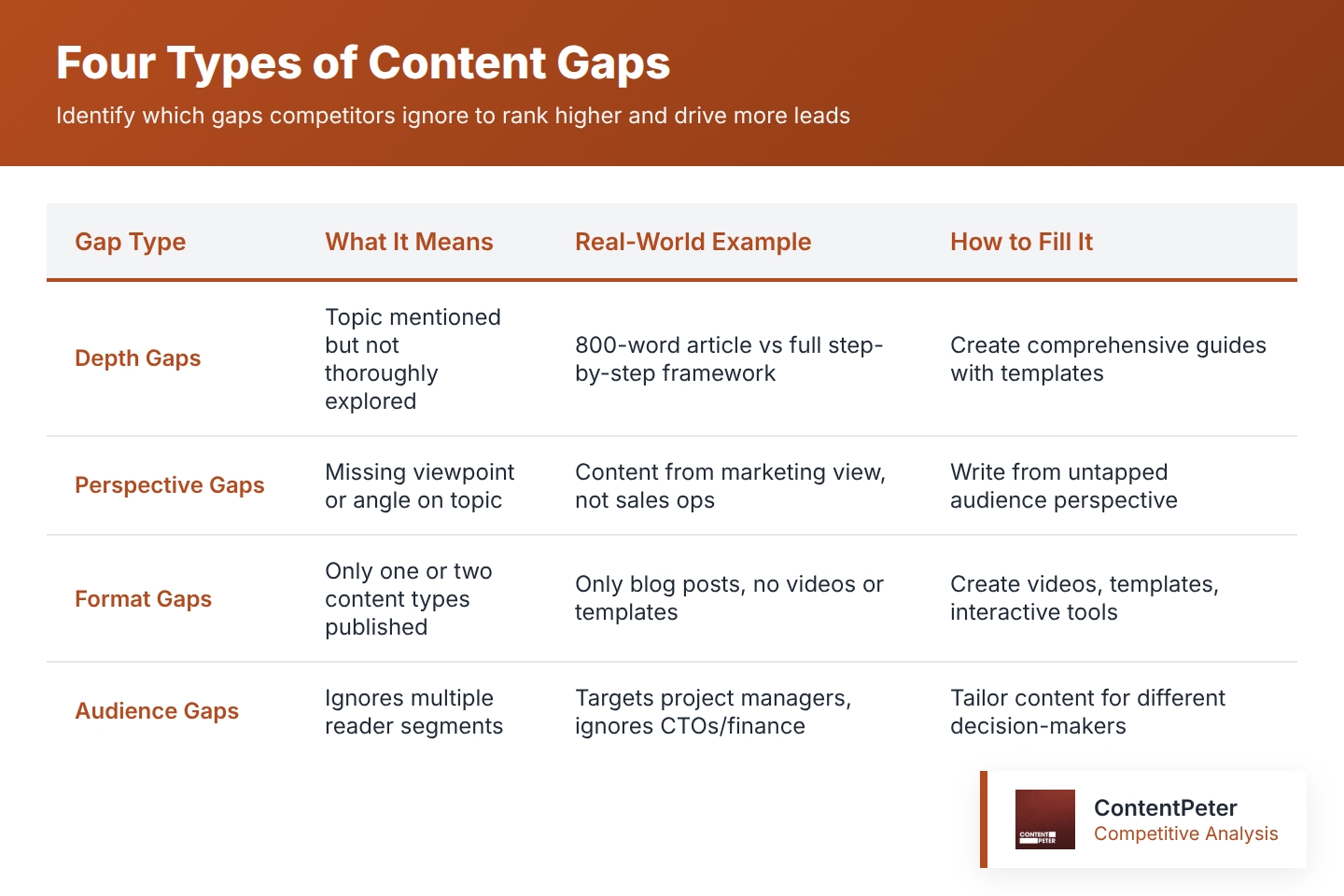
Four Types of Content Gaps
Depth gaps. Competitors mention a topic but don't explore it thoroughly. They write 800 words about "competitor analysis" when your audience needs a full step-by-step framework with examples and templates. That 800-word article touches the topic. Your comprehensive guide fills the depth gap.
Perspective gaps. No competitor has written from the angle you plan to take. Maybe every article about lead scoring comes from the marketing team's view. But sales operations leaders have completely different concerns. That's a perspective gap. Writing for that audience fills it.
Format gaps. Competitors publish blog posts but skip other formats. Maybe there's no video comparison, no downloadable template, no interactive checklist. Format gaps exist when competitors use only one or two content types for a topic.
Audience gaps. Competitors write for one reader segment and ignore others. An article titled "How to Choose Project Management Software" targets project managers. It completely ignores CTOs, finance leaders, or operations teams. Each of those segments represents an audience gap.
How to Identify Gaps in Practice
Search Google for your target keyword. Read the top 5 to 10 results. Ask yourself these questions:
• Which articles are short and surface-level (depth gap)?
• What angle is missing from all of them (perspective gap)?
• Is every result a blog post, or are there videos, templates, or tools (format gap)?
• Which reader roles aren't mentioned in any article (audience gap)?
Document what you find. You'll use this information in the next step.
Step 2: Analysis of Top Performers (Understand What Works)
Not all competitor content performs equally. Some articles rank high, drive traffic, and convert readers. Others publish and disappear.
Gap Identification tells you what's missing. Analysis of Top Performers tells you why the successful content succeeds. Understanding this pattern lets you fill gaps better than competitors did.
A key difference exists between monitoring competitors and analyzing them. Monitoring means tracking what competitors publish. Analysis means examining why certain content performs well, which keywords drive traffic, and how competitor strategies create business results.
What to Analyze
Look at your competitors' top-performing articles. You can find these by:
• Checking their blog homepage (featured articles appear first)
• Using SEO tools to see which of their pages rank for your target keywords
• Reading their most-shared content on LinkedIn or Twitter
For each top performer, examine:
The headline. What promise does it make? Does it include numbers, a problem, or a benefit?
The structure. Is it a list? A step-by-step guide? A comparison? Why did they choose this format?
The depth. How many words? How many sections? Do they include examples, data, or templates?
The angle. What makes this perspective unique? What problem does it solve for readers?
The call-to-action. What do they ask readers to do next?
Document the patterns you find. If three top competitors all use numbered lists, that format clearly works for that topic. If every top performer includes specific data or statistics, your article needs them too.
Why This Matters for Your Content
You're not copying competitors. You're learning what your readers expect from content on this topic. When you understand what top performers do right, you can do it better while filling the gaps they left open.
Step 3: Positioning & Differentiation (Create Your Unique Angle)
You've identified gaps. You've studied what works. Now you need a unique angle that fills gaps while delivering what searchers expect.
This is where positioning happens. Positioning means deciding what makes your content different and better than what already exists.
Understanding competitor messaging helps companies position themselves effectively and find opportunities for growth. Your positioning should answer one key question: what can I offer that competitors don't?
How to Position Your Content
Use the gaps and top-performer analysis you've already done. Ask yourself:
• Which gap can I fill that competitors completely ignore?
• How can I address the same problem from a new perspective?
• What format would serve readers better than what currently exists?
• Which audience segment needs this information but can't find it elsewhere?
Choose one or two of these. That becomes your differentiation strategy.
Example 1: Competitors write blog posts about "competitor analysis." You create a step-by-step framework article with templates, worksheets, and implementation guides. You're filling the depth gap with a format (downloadable tools) that competitors didn't provide.
Example 2: Every article about choosing software targets the decision-maker. You write for the technical team who will actually use it. You fill the audience gap while meeting a real reader need.
Your unique angle doesn't need to be complex. It just needs to address something competitors missed while delivering what searchers expect.
Step 4: Systematic Process (Repeat This at Scale)
The real power of GAPS isn't in analyzing one article. It's in building a repeatable process so you can do this for every piece of content you create.
When you establish a clear framework, research becomes faster and more consistent. Teams that systematize their competitive analysis process see dramatic improvements in both speed and quality.
Building Your Repeatable System
Create a simple checklist or template:
1. Identify the target keyword or topic.
2. Search your competitors' top 10 results.
3. Document the four gap types you found.
4. List top performers and what makes them work.
5. Write down your unique angle based on gaps.
6. Build your outline around that angle plus what top performers do well.
Use the same checklist for every article. After three or four times, it becomes automatic.
The time investment drops. The consistency rises. You stop guessing about what content works and start knowing it because you've studied your competitive landscape systematically.
Putting GAPS Into Action
Competitor content analysis doesn't require expensive tools or advanced skills. It requires a framework that guides your thinking.
GAPS helps you find the content opportunities competitors leave open. It helps you understand why certain strategies work. It helps you position your content to stand out. And it gives you a process you can repeat at scale.
The companies winning in B2B content right now aren't the ones monitoring competitors. They're the ones analyzing them systematically, filling gaps consistently, and building content strategies on data instead of guessing.
Start with one article. Run it through the GAPS framework. Document what you learn. Then use that same process for the next piece. Over time, your competitive advantage compounds.
You'll publish content that addresses what searchers actually need. You'll rank for keywords competitors ignore. And you'll differentiate in a crowded market through systematic analysis rather than guesswork.
Ready to build a content strategy on competitive intelligence instead of guessing? The GAPS framework works best when you integrate it into every article you publish. At ContentPeter, we run competitive analysis automatically for each piece we create, filling gaps and positioning content to win in search and conversions. Approve your content calendar once a month. Everything else runs automatically.