Learn the S.A.L.E.S. Framework for building a B2B SaaS sales team that scales. Discover when to hire your first SDR, AE, and how to structure teams at each growth stage.

Updated on
2026-02-03
Here's the approach that works for early-stage SaaS: structure, alignment, layering, execution, and scaling. We call it the S.A.L.E.S. Framework.
S stands for Structure. This is how your team is organized and when the founder steps back.
A stands for Alignment. Everyone knows their role, their targets, and who they report to.
L stands for Layering. You hire in a specific sequence, not all at once.
E stands for Execution. You document your process before you scale beyond the founder.
S stands for Scaling. You add specialization only when you're ready.
These five pieces work together. Miss one and your team struggles. Get all five right and you grow without chaos.
Let's break each one down.
Your sales structure changes as you grow. There's no single "right" structure for all SaaS companies. But there is a right structure for your stage.
When you're pre-product-market fit, you're the sales rep. This isn't a temporary problem. This is validation. You're learning what actually sells. You're talking to customers and hearing their real problems. You're the best person for this job right now.
When you hit $0 to $500,000 in annual recurring revenue, bring on your first sales hire. This person should be a Sales Development Rep (SDR) or Business Development Rep (BDR). Their job is outbound prospecting: finding leads, qualifying them, and scheduling meetings with you.
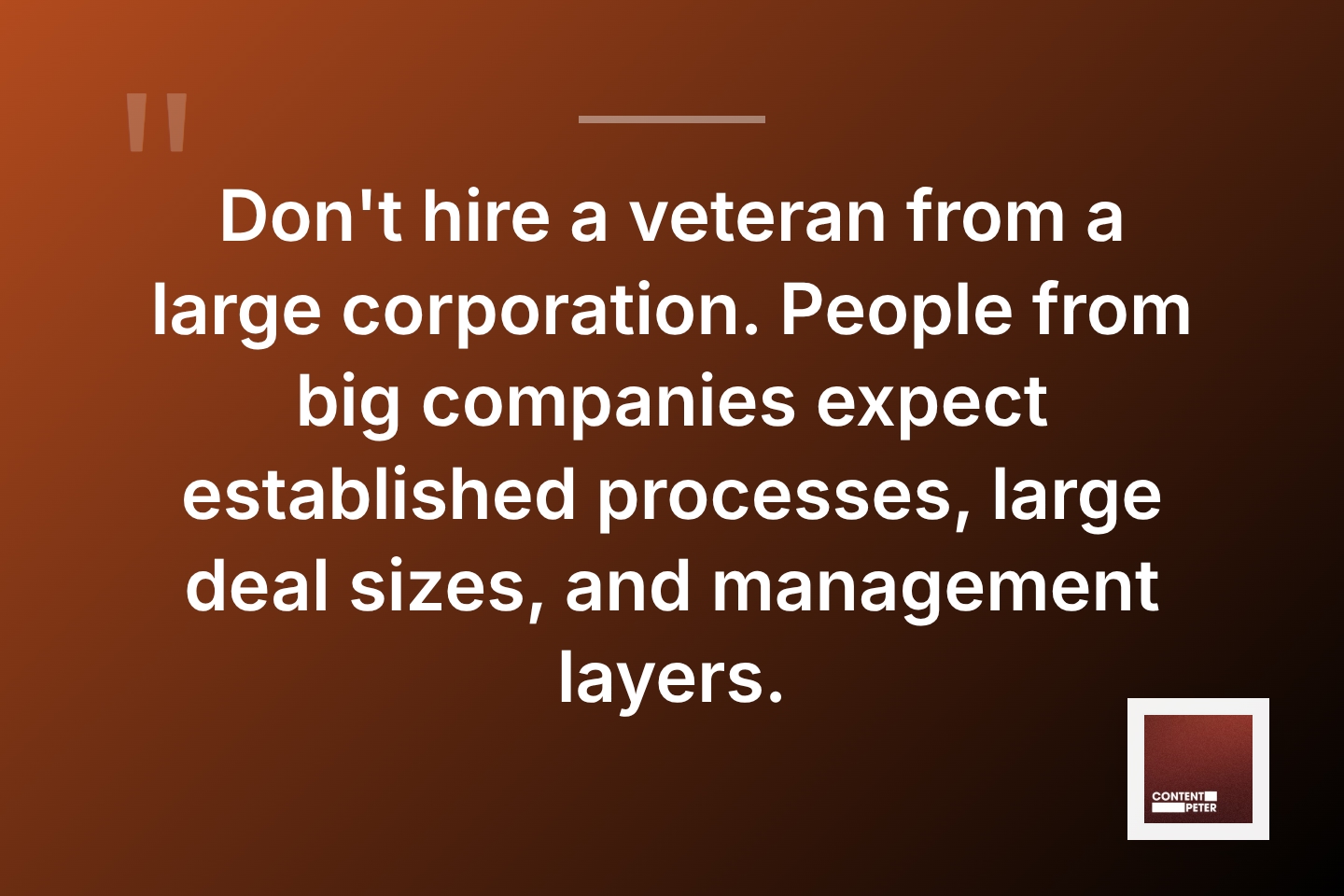
Here's the catch: hire someone with startup experience. Don't hire a veteran from a large corporation. People from big companies expect established processes, large deal sizes, and management layers. They'll either leave or struggle. This is one of the biggest hiring mistakes early-stage founders make.
When you hit $500,000 to $2 million in ARR, add an Account Executive (AE). This person closes deals. The founder still finds some deals. The SDR finds prospects. The AE turns them into customers.
The best approach is hiring 2 or 3 sales reps at once, rather than one at a time. Teams perform better when they have peers. A solo hire can feel isolated. Multiple hires create energy and accountability.
At this stage, your structure looks like this: Founder. SDR. AE. Simple. Clear. No overhead.
Structure tells you who sits where. Alignment tells you what success looks like.
Everyone on your team needs to know three things: What is my job? What am I measured on? Who do I report to?
For SDRs and BDRs, the job is clear. Schedule qualified meetings for the AE or founder. Success metrics include the number of meetings booked per week and the response rate from outreach.
For Account Executives, the job is closing. Success is measured in revenue closed. In early stage, there's more nuance. An AE should also hit activity targets: number of discovery calls, number of proposals sent, and sales cycle length.
Clear reporting structures matter enormously. Confusion about who reports to whom creates delays and duplicated work.
Here's what works: SDRs report to the Founder or Head of Sales. AEs report to the Founder or Head of Sales. One person owns sales decisions.
In early stage, this is almost always the Founder. As you grow past $2 million ARR, you might hire a VP of Sales. But not before.

Timing is everything. Hire too early and you're burning cash on people you don't need. Hire too late and you miss revenue.
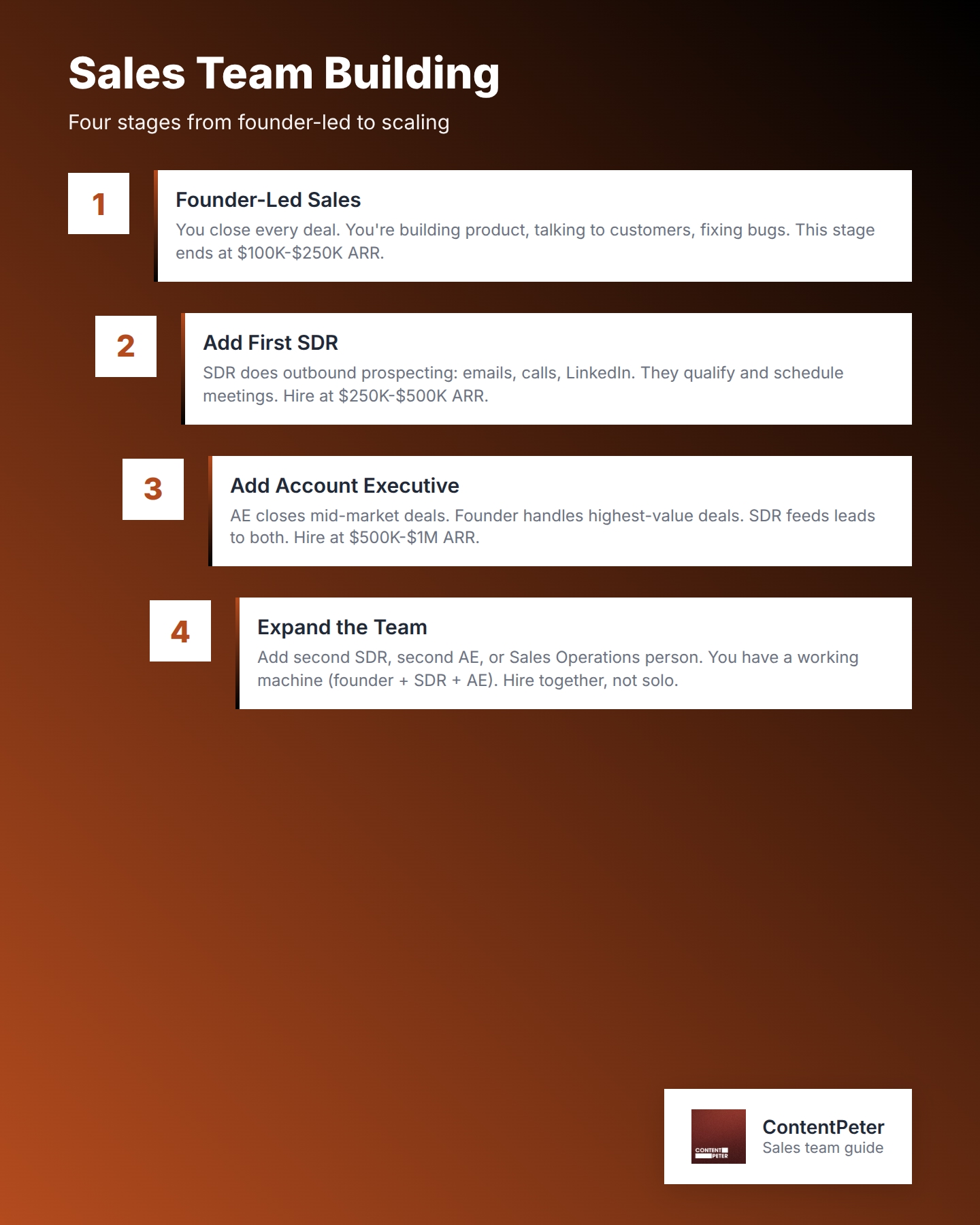
Sales team building breaks into four clear stages:
Stage 1: Founder-Led Sales. You're closing every deal. You're also building the product, talking to customers, fixing bugs. You're stretched thin. This stage ends when you hit roughly $100,000 to $250,000 in ARR.
Stage 2: Add Your First SDR. This person does outbound: emails, calls, LinkedIn messages. They're not closing. They're qualifying and scheduling. They free you up to close bigger deals and spend time on strategy. This hire happens around $250,000 to $500,000 ARR.
Stage 3: Add Your First Account Executive. The founder now focuses on the highest-value deals and relationship building. The AE closes mid-market deals. The SDR feeds both of you. This hire happens around $500,000 to $1 million ARR.
Stage 4: Expand the Team. Once you have a working machine (founder + SDR + AE), you can add more people. A second SDR. A second AE. Maybe a Sales Operations person to manage tools and data.
Don't compress these stages. Hiring two people at once when you're at $300,000 ARR is usually a mistake. You're not ready. Your processes aren't documented. Your founder doesn't have time to onboard them properly.
The exception: hire 2 or 3 reps together once you're ready for stage 4. Competitive team structures work better than solo hires.
Here's where many startups fail. They skip this step.
You can't scale sales without processes. Once you have more than one SDR or one AE, people work differently. One person closes deals three ways. The other closes deals two different ways. You lose consistency. You lose predictability.
Before you hire your second SDR or second AE, document what the first one actually does. What's the email sequence? What's the call script? What questions do you ask in discovery calls? How do you handle objections?
Documenting processes early (before team scaling) creates leverage. New hires ramp faster. They perform better. They stay longer.
This doesn't mean rigid scripts. It means best practices. It means "here's what works for us."
Once you're past $2 million ARR, you can think about specialization.
There are two specialization models: functional specialization and account-size specialization.
Functional specialization means some people do only outbound (SDRs). Some people do only closing (AEs). Some people manage existing customers (Account Managers). Each role is narrow and deep.
Account-size specialization means some AEs focus on small deals. Some focus on mid-market. Some focus on enterprise. Each person becomes an expert in their segment.
Which model is right for you depends on your product, your deal sizes, and your team size. But don't choose until you have real data. You need at least 6 months of sales history to know what's working.
The recommendation is to wait until you hit $2 million to $5 million ARR before specializing. At that point, your hiring rate is clear. Your sales process is proven. Your compensation structure is working.
Before that, keep roles flexible. Your first AE should be comfortable prospecting, qualifying, and closing. Your first SDR should be comfortable with outreach and relationship building. Flexibility beats specialization in early stage.
Here's the model in practice:
You're a founder with a SaaS product and $200,000 ARR. You're closing deals, but you're exhausted. Hire an SDR. Have them do outbound. Focus your time on high-value deals and customer success.
You hit $600,000 ARR. Hire an AE. The AE closes mid-market deals. The SDR feeds leads to both of you. The founder handles relationships and strategy.
You hit $1.5 million ARR. Document your sales process. What's working? What's not? Make it repeatable.
You hit $2 million ARR. Now you can hire a second AE or a second SDR. Or both. You're ready to specialize. You can think about a VP of Sales role. You can implement more sophisticated compensation models.

This pattern works. It's what successful founders do. The cost of getting it wrong is high: hire too early and you burn cash; hire the wrong people and you destroy culture and miss revenue targets; hire too late and you leave money on the table.
Get it right: structure matches your stage. Everyone knows their role. You hire in sequence. You document before scaling. You specialize only when ready.
That's how you build a sales team that actually works.