Learn Query Fan Out optimization to capture multiple search variations with one strategic article. Discover how AI systems break down queries and how to rank for all of them.

Updated on
2026-01-22
Your content strategy is built on a flawed assumption. You're optimizing pages for single keywords. You're creating one article per topic. You're measuring success by traditional search rankings.
But here's what's actually happening when someone searches today: AI systems like Google AI Mode, ChatGPT, and Perplexity don't just look for your exact keyword. They break that one query into multiple sub-questions. Then they pull answers from pages ranking for those variations.
If your content only targets the main keyword, you're invisible in the answers AI actually returns.
This gap is costing you visibility in both traditional search rankings and AI answers. Most B2B content teams are missing search variations that AI systems actually query. The solution is Query Fan Out optimization.
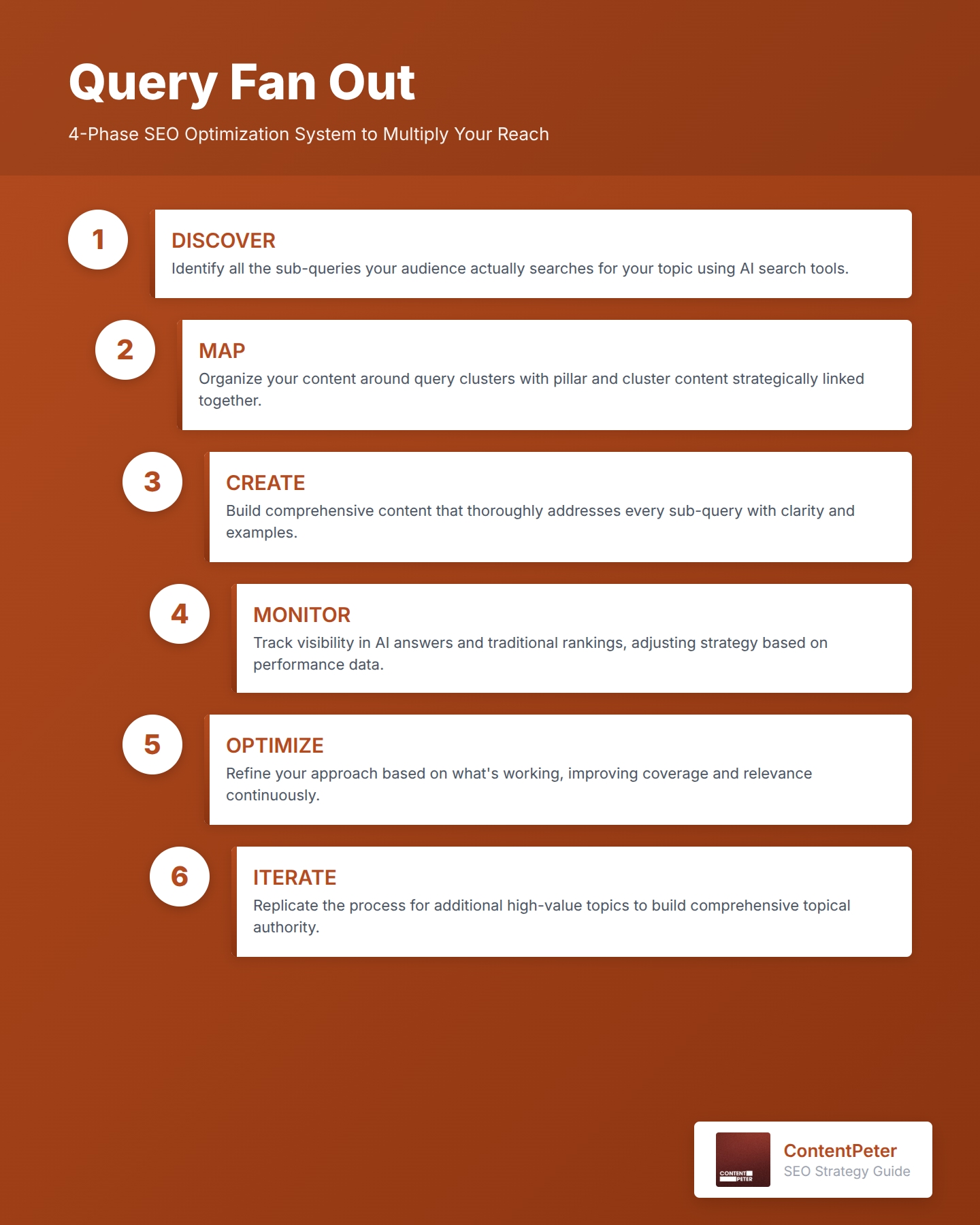

Now you understand the sub-queries. The next step is organizing your content strategically.
This is where most teams fail. They create isolated blog posts for each sub-query. Then they wonder why they have keyword cannibalization. Why their internal linking is messy. Why traffic distribution is chaotic.
Instead, think in topic clusters.
A topic cluster centers on one broad theme. It includes multiple pages or sections addressing specific subtopics. Then you link them to each other. This approach reinforces your topical authority. AI systems reward sites that cover subjects exhaustively and link related concepts together.
Here's how to map for your topic:
Identify your pillar content. This is your comprehensive, long-form article addressing the main query and all major sub-queries.
Identify your cluster content. These are supporting sections or pages within the pillar. Each one dives deeper into one sub-query.
Connect them with internal links. Use internal links that reference the actual sub-query language. Link from detailed sections back to the pillar.
For our CRM example, your pillar would be "Complete Guide to CRM Software for B2B SaaS." Your clusters would be sections like "Key Features SaaS Companies Need," "Integration Capabilities," "Pricing Models," and "Scalability Options."
Each section directly addresses one sub-query. Readers who land on any section see the complete context.
Now comes the actual writing. But your approach is different from traditional content creation.
You're not creating separate articles for each keyword. You're creating one strategic pillar with comprehensive coverage.
Your pillar article should address every sub-query discovered in Phase 1. Address them thoroughly. Show your expertise on each angle.
The optimization strategy is straightforward: identify the sub-queries around your topic. Then make sure your page includes content targeting those queries. If you do that, you have better odds of being selected in AI answers.
Practical approach:
Create a section for each sub-query. Build a major section for each primary sub-query you discovered. Use its language in the heading.
Answer the "why." Don't just state facts. Explain why each sub-query matters to your reader.
Include specific examples. Show how this applies to real situations your audience faces.
Link internally. Reference other sections when sub-queries connect. This reinforces your topical authority.
Write for AI systems too. Use clear language. Define terms clearly. Put key information early. AI systems reward clarity.
The result is one comprehensive article that ranks for multiple related queries, not just one.
Traditional SEO reports miss critical data. They show rankings. They don't show AI answer visibility.
You need to monitor both.
For traditional rankings, use your existing tools (Ahrefs, SEMrush). But add a new metric: AI answer appearance.
Here's how:
Weekly check. Search your main query in Perplexity and Google AI Mode. See if your content appears in the answers.
Check sub-queries too. Search a few of your discovered sub-queries. Note which ones surface your content.
Track changes over time. Use a simple spreadsheet. Log date, query, ranking position, and whether you appeared in the AI answer.
Visibility in AI answers changes as the system processes new content and adjusts its answers. Monitoring helps you identify what's working and what needs adjustment.
If you rank well for your main query but don't appear in AI answers for sub-queries, that's your signal. You need deeper coverage of those specific angles.
Your team faces a real challenge: you need consistent blog content to rank and drive leads. Traditional approaches don't work anymore.
Hiring a content person is expensive. Managing freelancers is chaotic. Using AI tools without editorial oversight produces unreliable results.
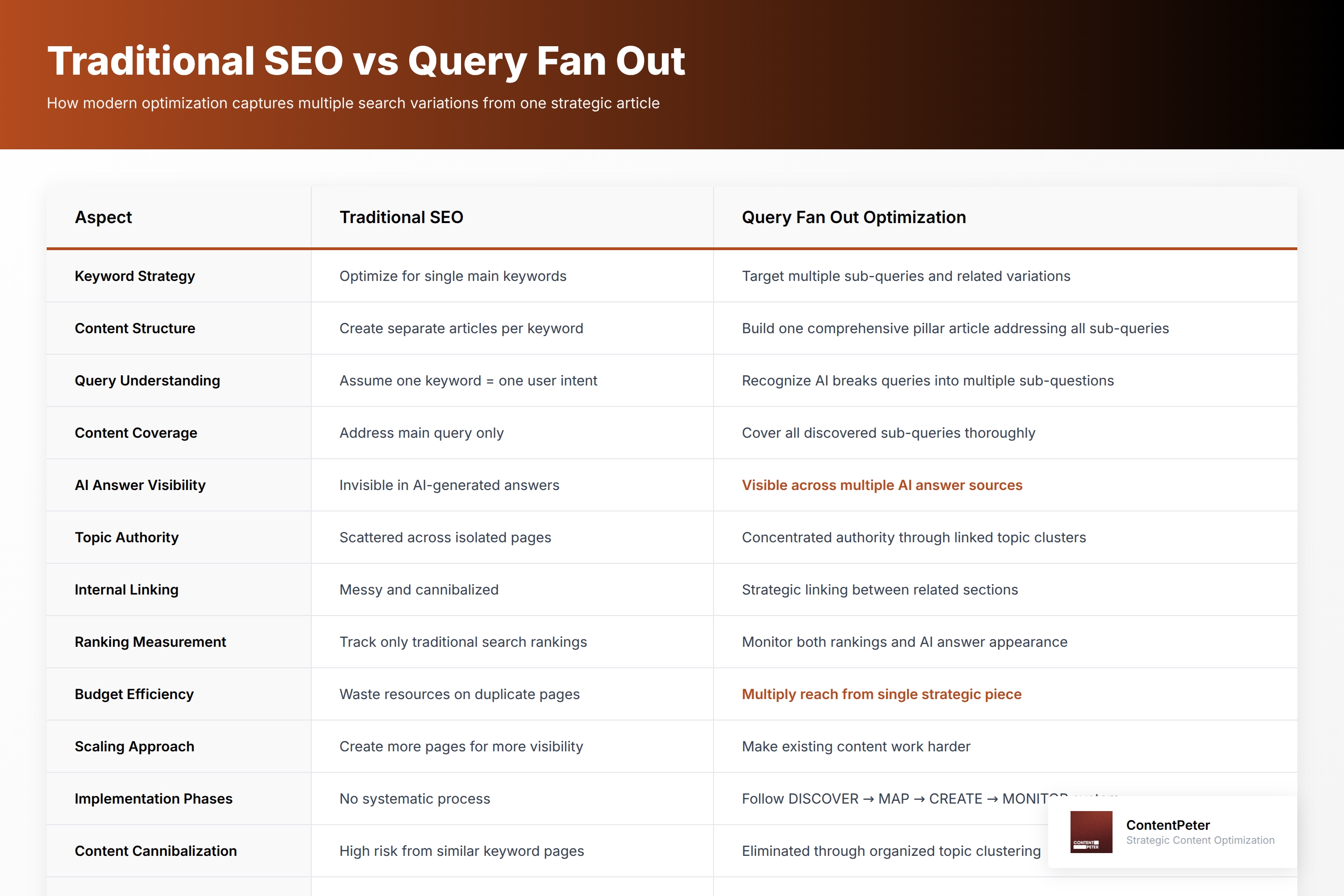
Query Fan Out optimization solves this by making your content work harder. One strategically built article now captures traffic from multiple query variations. You're not creating keyword cannibalization. You're not wasting budget on duplicate pages. You're multiplying reach from a single piece of content.
This approach compounds over time. As you optimize more articles using Query Fan Out methodology, your topical authority grows. Your AI answer visibility increases. Your traditional rankings improve too.
The implementation is straightforward: discover your sub-queries, map your content structure, create comprehensive coverage, and monitor results. No expensive tools required. No hiring overhead.
You don't need to overhaul your entire content strategy tomorrow. Start with one topic.
Pick your highest-value keyword. The one driving the most search volume. The one that would convert best.
Go through Phase 1 this week. Discover the sub-queries. Document them.
Then map your content strategy. Plan your structure.
Then create or update one pillar article using the sub-query insights.
Monitor for two weeks. See what moves.
That single article will show you the power of Query Fan Out optimization. You'll see visibility increases in both traditional search and AI answers.
Then replicate the process for your next highest-value topic.
Over time, you build a content library that ranks for multiple related queries. You drive more leads. You waste less budget. You create consistent, strategic content that compounds.
That's the power of Query Fan Out.