Contents
Zero-click search kills generic, surface-level content an AI can write itself. It leaves your case studies, proprietary data and first-hand expertise untouched, because AI answers still need something real to cite. The fix is not a rewrite. Take one existing article, pull your original insight up to the top, and you become the source the AI quotes instead of the page it skips.
What zero-click search actually kills
Zero-click search sounds like a traffic problem. It is really a content-quality problem wearing a traffic costume.
Here are the numbers. SparkToro's 2026 study, built on Similarweb clickstream data, found Google searches ended without a click 68.01% of the time in the US during the first four months of 2026. That is up from 60.45% in 2024, a 7.56-point jump in two years. And getting cited is not the rescue you might hope for. According to a survey by Exploding Topics, less than 19% of people actually click on citations in AI overviews. So even when your content is being cited, you are probably not seeing the traffic.
Read that carefully and you can see what is dying and what is not. The searches vanishing are the ones an AI can answer on its own: definitions, basic how-tos, listicles that restate what ten other pages already said.
I think it kills superficial content, content that has no added value and can be delivered by an LLM. What survives is anything the model cannot generate from its own training: your numbers, your client's before-and-after, the thing you learned running the campaign yourself.
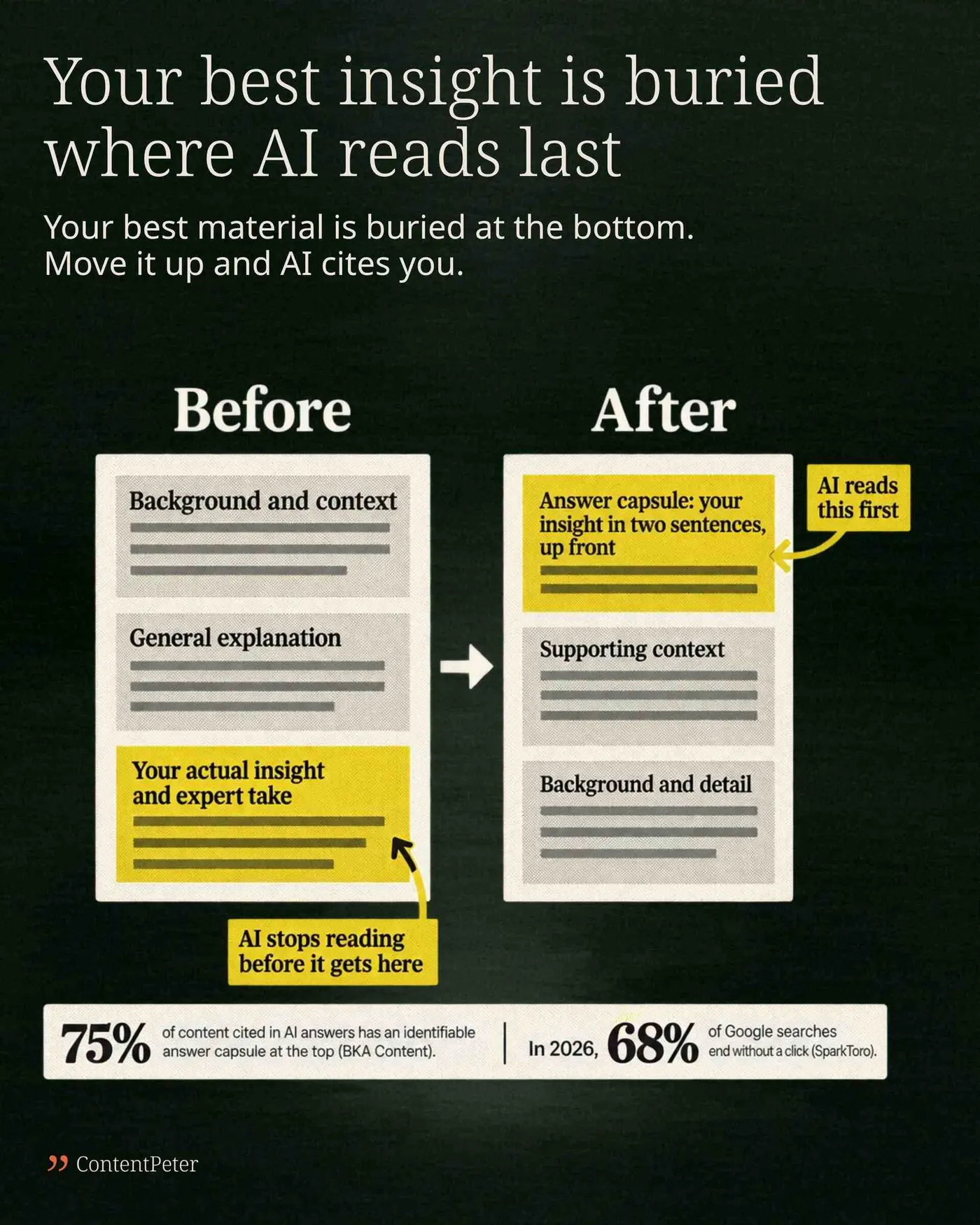
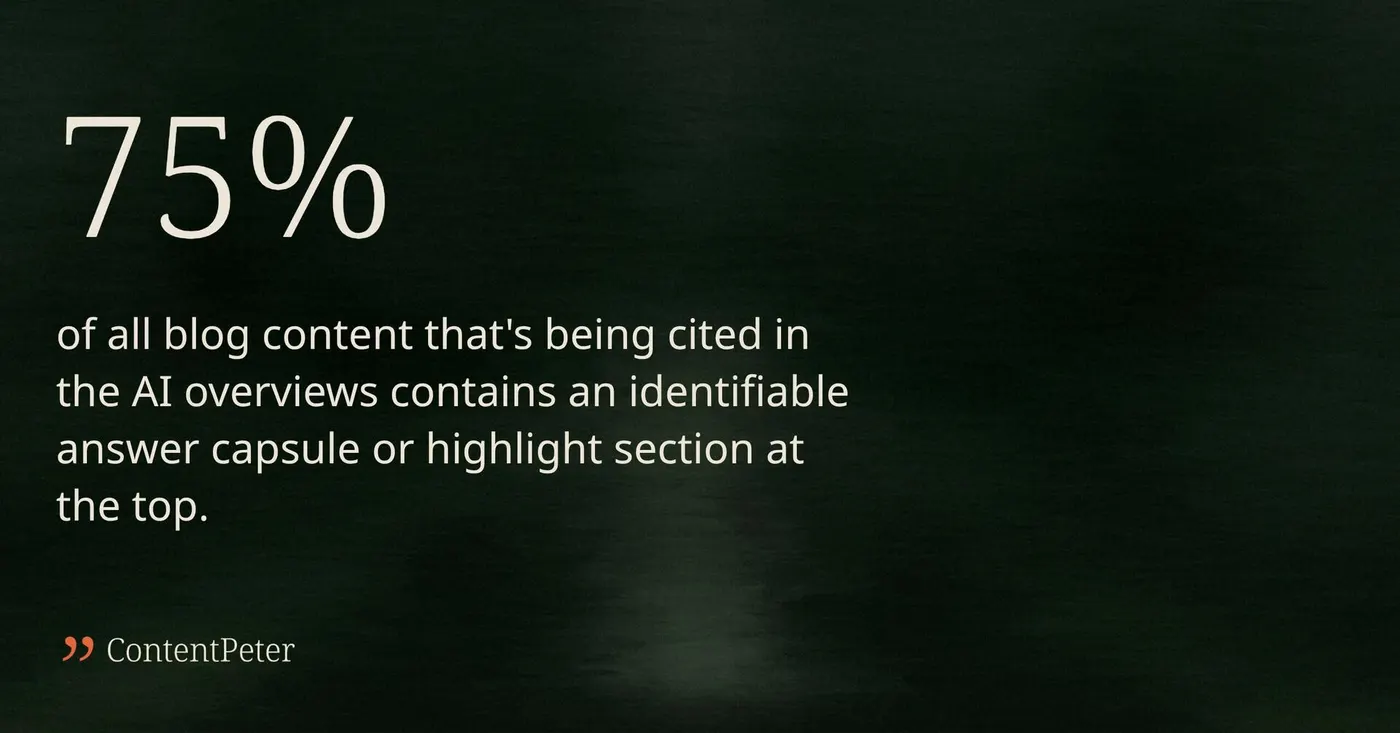
There is a structural tell here too. BKA Content found that over 75% of all blog content being cited in AI overviews contains an identifiable answer capsule or highlight section at the top. The material AI cites is real, and it is easy to find on the page. Both things have to be true.
The article structure AI search walks straight past
Picture the standard SEO blog post you have published a hundred times. A 200-word intro warming up to the topic. Three subheadings that answer the obvious question everyone else already answered. Then, somewhere near the bottom, the one paragraph with your actual data or your client story.
That shape was built to satisfy a word count and a keyword, not a reader in a hurry. It worked when Google showed ten blue links and people scrolled. It fails now for a specific reason.
As Wordtracker reports, 58.5% of searches in the US and 59.7% in the EU end in a zero-click, meaning the user ends the session or runs a new query without clicking anything. The answer engine handled it. BKA Content puts the stakes plainly: these tools don't show 10 blue links like Google. They give one answer, one result with a handful of citations attached. If your brand is one of the main sources that it pulls from to create that answer, you win. But if your brand isn't cited or mentioned in that answer, you're not even a part of the conversation.
So an AI reads your post top to bottom. The first 80% is generic, so it takes the generic answer from someone with more authority. Your one original paragraph, the reason the post deserved to exist, sits too far down and too buried to register.
The insight was always in appendix B. Nobody read appendix B.
But if you have a person that takes your own stories, expertise, case studies, real stuff, then it's it's not affecting you. The structure is the problem, not the substance.
Three moves that surface what AI will cite
You do not need to rewrite the article. You need to relocate its value and refresh it. Three moves do that.
One: lead with your proprietary claim. Open with the specific finding only you have. "Across the 40 onboarding flows we audited, the drop-off happened at step three, not checkout." Put your number, your result, your first-hand observation in the first paragraph, where an answer engine reads it first.
Two: build a real answer capsule. Directly under the headline, give a tight two-to-four sentence answer to the exact question the article addresses. This is the highlight section AI overviews favour. It also serves the human who wants the point before the scroll.
Three: date and refresh it. This one is easy to skip and it matters. Ahrefs found that content cited by AI is 25.7% fresher than the content that shows up in regular Google results. Add this year's data, revisit the claim, mark the update. Stale pages lose the slot even when the insight is good.
Notice what none of these ask you to do. None of them say answer every basic question or strip your voice out to feed the machine. Over-optimizing for extraction is the overrated move. Optimize for value and human insight instead, and the citation follows.
One caution to hold onto here. There's always going to be a change in the algorithm and it will affect those pages that have tried to game the algorithm. Move your real expertise up front and you are not gaming anything. You are just making it findable.
One article, before and after
Take a post titled "How to reduce SaaS churn." The version you published follows the failing shape: a general intro, five obvious tips (send onboarding emails, offer support, gather feedback), and near the end, a paragraph noting that your own cohort analysis found churn spiking in week two, not month three.
An AI answering "how do I reduce SaaS churn" pulls the five obvious tips from a domain bigger than yours. Your week-two finding never surfaces. The post ranks and earns nothing, which is the trap so many teams sit in now. SparkToro measured 68.01% zero-click in early 2026, up from 60.45% in 2024, a 7.5-point climb in two years. Ranking is no longer the same as being read.
Now apply the three moves. New opening line: "In our analysis of 60 B2B SaaS accounts, churn concentrated in week two of onboarding, before customers ever saw core value." Under the headline, a four-sentence capsule answering the question and naming that week-two finding. A dateline showing this year's refresh.
Same article. Same underlying work. The difference is that your proprietary claim now sits where an answer engine reads first, phrased as something no model can invent. It becomes the citeable line.
It is worth knowing the click ceiling is real even done right. One reading of the SparkToro data argues the true zero-click rate is closer to 37.1%, since 21.4% of searches lead to another search rather than nothing. Either way, plenty of demand ends without a visit. So the goal is being the named source in the answer, which builds recognition even without the click.
But if you are always optimizing for humans, then you should always be fine.
Why the team that moves first keeps the slot
Here is the part that turns this from a nice idea into something you do this week. AI answers are not a ranked list where positions shuffle daily. They cite a small, sticky set of sources, and once a citation forms around a question, it is durable.
Exploding Topics reports that only 41% of Google searches now result in someone clicking through to a website. So the majority of demand is being satisfied inside the answer, and the sources named in that answer are the ones people see. Being the cited source is the visibility now.
Two things make the position defensible. First, the answer surfaces one result with a handful of citations, not ten links, so there is genuine scarcity in who gets named. Second, the sets barely overlap across platforms. Ahrefs compared the sources three AI assistants pulled from and found only seven domains appeared on all three lists, with 86% of sources unique to each assistant. That fragmentation cuts both ways: no single competitor can occupy every engine, which means an early, specific, well-structured page can claim the slot on the ones that matter to you.
Your competitors are still publishing the generic version, the one an LLM writes for free. The window is the gap between now and when they notice. Take one article that already holds your best proprietary insight, move that insight to the top, refresh it, and you plant a flag on a question before anyone else does.
The citation slot fills up. The first team there keeps it.
Key takeaways
- Zero-click kills generic content, not yours. With 68.01% of US searches ending without a click in early 2026, the pages that vanish are the ones an LLM can reproduce. Case studies, proprietary data and first-hand expertise still get cited.
- Structure, not substance, is usually the problem. Your best insight often sits buried near the bottom where AI reads it last. That is the appendix B problem: the value was always there, nobody found it.
- Three moves fix one article: lead with your proprietary claim, add a short answer capsule under the headline, and refresh the date and data. Ahrefs found AI-cited content runs 25.7% fresher than standard results.
- Do not over-optimize. Answering every basic question to feed extraction is the overrated response. Optimize for human value and the citation follows.
- Move first. AI answers cite a small, sticky set of sources, and 86% of those sources differ across assistants. The early, specific page claims the slot and holds it.
Questions readers ask
What content strategy works for zero-click search in 2026?
Lead with material an AI cannot generate on its own: your data, your case studies, your first-hand results. Publish a tight answer capsule at the top of each article, keep the content dated and refreshed, and stop padding posts with generic answers everyone else already gives. The aim is to be the named source inside the AI answer, not to rank a link nobody clicks.
How should publishers adapt when AI surfaces the answer before the click?
Accept that ranking no longer equals being read, since Exploding Topics found only 41% of searches now reach a website. Restructure existing articles so your proprietary insight is the first thing an answer engine reads. Being cited builds recognition even without the click, and BKA Content notes that if your brand is not in the answer, you are not in the conversation at all.
Which content types stay valuable in zero-click SERPs?
Case studies, original research, proprietary benchmarks and genuine expertise survive because an LLM cannot fabricate them. Superficial listicles and basic definitions die, because the answer engine handles those itself. BKA Content also found that over 75% of blog content cited in AI overviews has a clear answer capsule up top, so format the survivors for easy extraction.
Do I need to rewrite my whole content library?
No. Start with one article that already contains your best insight, move that insight to the opening, add an answer capsule, and refresh the data. The work is relocation and updating, not starting over. Your best material is usually already written, just buried where AI cannot find it.
See one idea on every channel
The LinkedIn post, the X thread, the carousel and the newsletter, from the same idea.

Content editor with a passion for blending AI efficiency with human editorial craft. I make sure that we create content that actually sounds like a human wrote it and gets results.
LinkedIn